
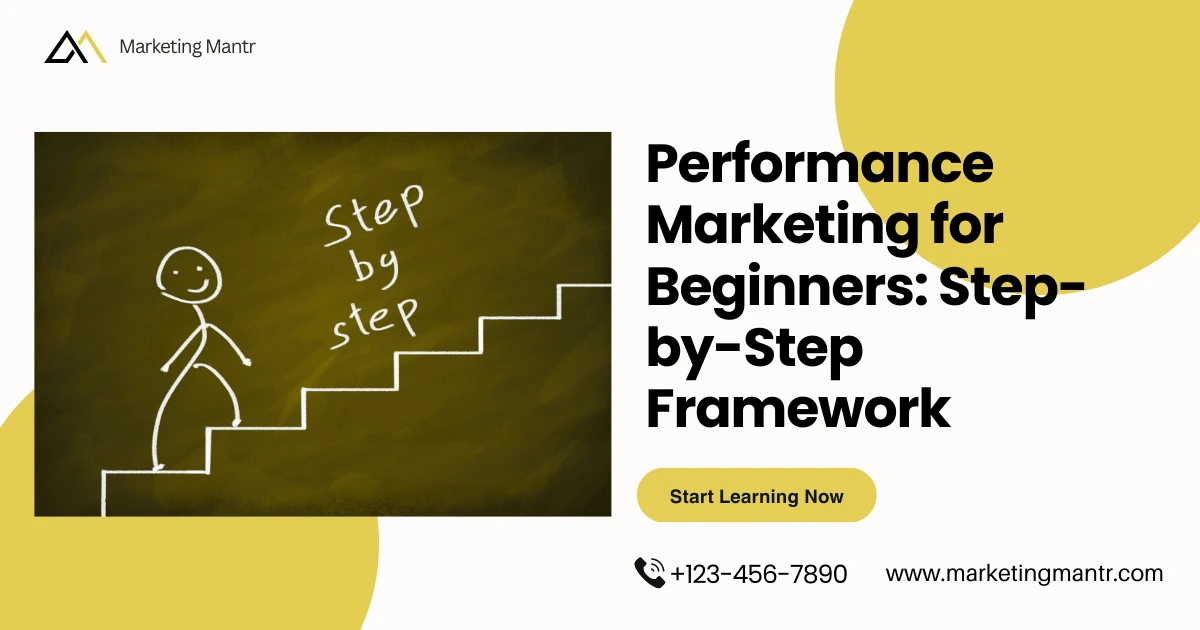
Performance Marketing 101: How to scale your business with data-driven strategies.
Digital marketing has evolved rapidly over the past decade, and businesses today no longer settle for vague metrics like reach or impressions alone. They demand clarity, accountability, and measurable outcomes. This is where understanding what performance marketing is becomes essential, as it focuses on a results-driven approach where marketers track, analyze, and optimize every action for specific business goals.
For beginners, performance marketing may seem complex at first, filled with technical terms, dashboards, and data points. However, when you understand it correctly, it becomes one of the most powerful and scalable marketing strategies available. At Marketing Mantr, we treat performance marketing not as a one-time campaign, but as a structured framework that helps businesses grow predictably and sustainably.
Understanding Performance Marketing
Performance marketing is a digital marketing approach where advertisers pay based on specific actions rather than just exposure. These actions can include website clicks, lead submissions, app installs, or purchases. Unlike traditional marketing, where measuring success often becomes difficult, performance marketing focuses entirely on measurable outcomes.
What makes performance marketing unique is its accountability. Marketers can track every rupee spent back to a result, making it ideal for businesses that want transparency and ROI-focused growth. Platforms such as Google Ads, Meta Ads, LinkedIn Ads, and affiliate networks play a central role in these strategies.
At Marketing Mantr, we start with one simple question: What result does the business actually want? Everything else flows from that clarity.
Step One: Defining Clear Business Goals
Clear goals form the foundation of any successful performance marketing strategy. Without a defined objective, even the best campaigns can fail. Performance marketing does not start with ads; it starts by defining what success looks like.
Some businesses aim to generate qualified leads, while others focus on increasing online sales, driving app downloads, or booking consultations. Beginners often make the mistake of running ads without aligning them to a specific outcome, which wastes budgets and creates unclear results.
At Marketing Mantr, we always tie goals to business impact. Instead of vague targets, we build strategies around clear, measurable outcomes that directly support revenue growth.
Step Two: Understanding the Target Audience
Once you define goals, the next step is understanding who the campaign needs to reach. Performance marketing works best when you show ads to the right people at the right time. This requires a deep understanding of the audience their needs, challenges, interests, and online behavior.
Instead of targeting everyone, performance marketing focuses on relevance. When you know where your audience spends time, what problems they want to solve, and what motivates them, you can create campaigns that feel personal rather than promotional.
At Marketing Mantr, we treat audience research as a strategic asset. The more accurately we define the audience, the better the campaign performance and cost efficiency.
Step Three: Choosing the Right Performance Marketing Channels
Not every platform works for every business. Choosing the right channels based on audience behavior and goals is one of the most important steps in performance marketing.
Google Ads works well when users actively search for solutions. Meta Ads drive discovery, engagement, and retargeting. LinkedIn Ads performs strongly for B2B and professional services. Your platform choice directly impacts performance, costs, and conversion quality.
Beginners often spread budgets across too many platforms. A better approach is to start with one or two channels, test performance, and scale what works. At Marketing Mantr, we base channel selection on strategy not trends.
Step Four: Creating High-Converting Ad Creatives
In performance marketing, creative quality plays a crucial role. Ads are not just about visibility; they are about action. A strong creative speaks directly to the audience’s problem and presents a clear solution.
Effective performance marketing creatives focus on clarity rather than complexity. They highlight benefits, address pain points, and guide users toward a specific action. Visuals, copy, and messaging all work together to influence decision-making.
At Marketing Mantr, creatives are tested continuously. Performance marketing is not about guessing what works; it’s about letting data guide creative decisions.
Step Five: Building Conversion-Focused Landing Pages
Driving traffic is only half the job. Performance marketing success depends heavily on what happens after the click. This is where landing pages play a critical role.
A well-optimized landing page aligns perfectly with the ad message. It removes distractions, communicates value clearly, and makes it easy for users to take action. Slow loading times, unclear messaging, or complicated forms can significantly reduce conversions.
At Marketing Mantr, landing page optimization is treated as part of the performance marketing framework, not an afterthought. Even small improvements in conversion rate can dramatically increase ROI.
Step Six: Tracking, Measurement, and Analytics
What truly sets performance marketing apart is its focus on data. Every campaign is tracked using analytics tools that measure user behavior, conversions, and cost efficiency.
Tracking helps marketers understand which ads are working, which audiences are converting, and where budgets should be allocated. Without accurate tracking, performance marketing loses its purpose.
At Marketing Mantr, data is used not just for reporting but for decision-making. Performance insights guide optimization, scaling, and long-term strategy.
Step Seven: Optimization and Continuous Improvement
Performance marketing is not a “set it and forget it” strategy. It requires ongoing monitoring, testing, and optimization. Ads, audiences, creatives, and landing pages are constantly refined to improve results.
This iterative approach allows marketers to reduce costs, increase conversions, and improve ROI over time. Even small optimizations, when compounded, can lead to significant growth.
At Marketing Mantr, optimization is a continuous process. Performance marketing strategies evolve as data reveals new opportunities.
Step Eight: Scaling What Works
Once campaigns are delivering consistent results, the next step is scaling. Scaling does not simply mean increasing the budget; it means expanding intelligently while maintaining efficiency.
Scaling may involve targeting new audience segments, launching new creatives, or expanding to additional platforms. The key is to grow without losing control over performance metrics.
At Marketing Mantr, scaling is done strategically, ensuring growth remains sustainable and profitable.
Why Performance Marketing Is Ideal for Beginners
For beginners, performance marketing offers clarity and control. Instead of guessing whether marketing efforts are working, performance marketing provides real-time feedback. This transparency makes it easier to learn, improve, and grow.
It also allows businesses to start small, test ideas, and scale only what delivers results. This flexibility makes performance marketing accessible even for startups and small businesses.
Why Choose Marketing Mantr for Performance Marketing
At Marketing Mantr, performance marketing is built on strategy, data, and execution excellence. Every campaign is designed to align with business goals, audience behavior, and long-term growth objectives.
Rather than focusing on vanity metrics, Marketing Mantra prioritizes outcomes that matter: leads, sales, and revenue impact. Understanding what is performance marketing is key here, as it focuses on measurable results and ROI-driven strategies instead of just impressions or reach. The goal is not just to run ads but to build a performance-driven growth system.
More from our blog
See all posts






Recent Posts
- How to start solopreneur business in 2026 with ai tools ? April 25, 2026
- Instagram Marketing Strategy for Small Businesses February 17, 2026
- Best AI tools for digital marketing.(Fees and charges) February 17, 2026