
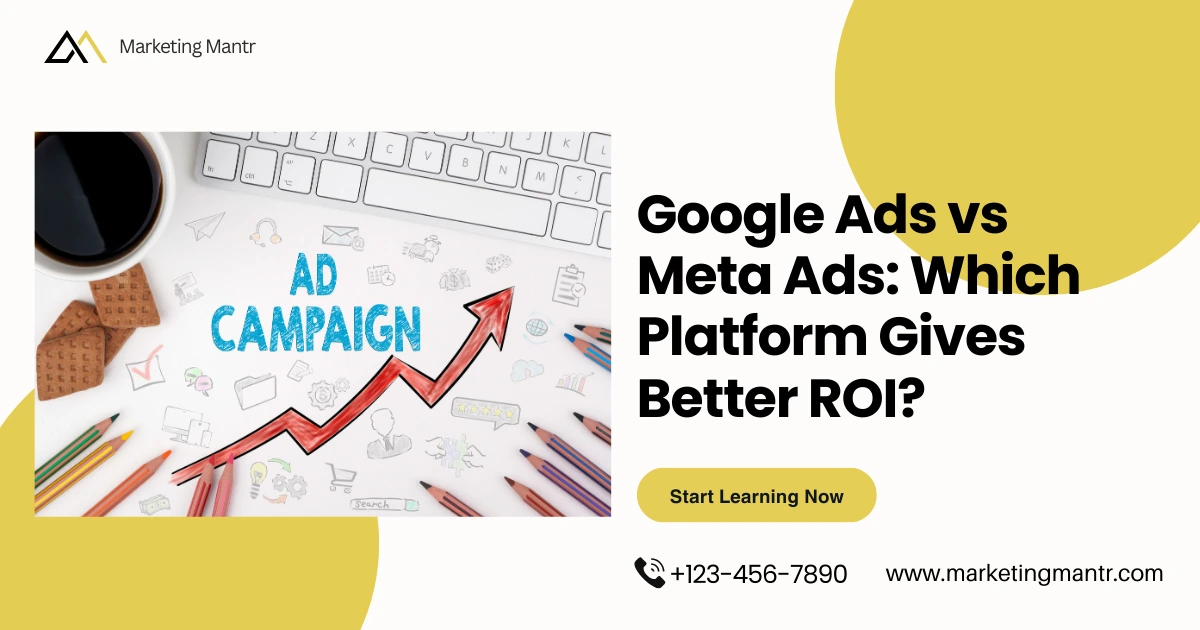
Choosing the right advertising platform: A side-by-side comparison of Google and Meta Ads.
Paid advertising has become a cornerstone of modern digital marketing. Businesses today don’t just want visibility; they want measurable returns on investment (ROI). Among the most powerful paid advertising platforms, Google Ads and Meta Ads (Facebook & Instagram) dominate the landscape. Understanding Google Ads vs Meta Ads is crucial for marketers who want to choose the right platform based on performance and business goals.
But when budgets are limited and performance matters, one critical question arises:
Google Ads vs Meta Ads: Which platform gives better ROI?
At Marketing Mantr, we work with businesses across industries to design performance-driven ad strategies. The truth is, there’s no universal winner. The right platform depends on your business goals, audience behavior, and marketing funnel stage.
Understanding ROI in Advertising
Before comparing platforms, let’s understand what ROI means.
ROI (Return on Investment) measures how much profit you earn compared to how much you spend on ads.
Example:
If you spend ₹1,000 on ads and earn ₹5,000 in sales, your ROI is good.
If you spend ₹1,000 and earn ₹900, your ROI is negative.
So the goal is simple: spend less, earn more.
What is Google Ads?
Google Ads is a pay-per-click (PPC) advertising platform that allows businesses to show ads in Google search results, YouTube, and partner websites. Ads appear when users actively search for specific keywords, giving businesses access to high-intent audiences.
Example: A user searching “best SEO services near me” is likely ready to purchase or engage with a service provider. A well-targeted Google Ads campaign can capture this traffic effectively.
Key Features of Google Ads
Keyword Targeting
Ads trigger based on specific keywords that potential customers use.Ad Formats: Includes Search Ads, Display Ads, Shopping Ads, and YouTube Video Ads.
Bidding Strategies
CPC (Cost Per Click), CPM (Cost Per Thousand Impressions), CPA (Cost Per Acquisition).Ad Extensions: Adds extra information such as phone numbers, sitelinks, and location, improving click-through rates (CTR).
Advantages of Google Ads for ROI
High-Intent Audience
Users are actively searching for solutions, which increases the likelihood of conversions.
Detailed Analytics: Google Ads integrates with Google Analytics to track clicks, impressions, conversions, and cost per conversion.
Scalability: Easily adjust budget and bid strategy based on campaign performance.
Local Targeting
Great for businesses targeting specific locations or regions.
Understanding Meta Ads (Facebook & Instagram Ads)
What are Meta Ads?
Meta Ads are paid social media campaigns on Facebook and Instagram. They allow businesses to target users based on demographics, interests, behaviours, and engagement history, rather than active search intent.
Example: A new organic skincare brand can target women aged 25-40 who follow wellness pages or engage with beauty content even if they haven’t searched for your products yet.
Key Features of Meta Ads
Advanced Audience Targeting:
Build audiences using demographics, interests, past behaviours, and custom/lookalike audiences.
Ad Formats:
Stories, Reels, Carousel Ads, Video Ads, and Collection Ads.
Retargeting:
Re-engage users who visited your website or engaged with your content.
Creative Flexibility:
Focus on storytelling, visuals, and interactive content.
Advantages of Meta Ads for ROI
Brand Awareness & Engagement: Ideal for creating connections with your audience.
Cost-Effective CPC: Often lower cost per click compared to Google Ads.
Visual Marketing: Highly effective for products that rely on visuals to drive interest.
Audience Insights: Provides rich data for understanding your target audience.
Google Ads vs. Meta Ads: ROI Comparison
1. Cost Efficiency:
Google Ads: CPC is often higher due to competitive bidding, but the leads are high-intent, which can result in higher ROI per conversion.
Meta Ads: CPC is generally lower, making it attractive for awareness campaigns or retargeting.
Example: A SaaS company may spend $5 per click on Google Ads but convert 10% of users. The same campaign on Meta Ads might cost $1 per click but convert only 2%. ROI calculation depends on the value of each lead.
2. Audience Targeting:
Google Ads: Best for intent-based targeting. Reaches people actively searching for a solution.
Meta Ads: Best for interest-based targeting. Reaches people who may not yet be searching but fit your ideal customer profile.
Example: Google Ads works well for “buy now” searchers, while Meta Ads works well for awareness campaigns, retargeting, and impulse purchases.
3. Conversion Tracking & Analytics
Google Ads: Tracks conversions via Google Analytics; helps understand customer behavior and optimize bidding.
Meta Ads: Uses Meta Pixel to track website visits, conversions, and engagement.
Insight: Accurate tracking is key to calculating ROI and adjusting ad strategies.
4. Industry-Specific Performance
B2B Businesses: Often achieve higher ROI with Google Ads due to search intent.
B2C Businesses: May see better ROI with Meta Ads for visually appealing or lifestyle products.
Example: An e-commerce fashion brand may achieve a 3:1 ROI on Meta Ads but 2:1 on Google Ads, while a local IT service may achieve 4:1 ROI on Google Ads.
Which Platform Is Better for Small Businesses?
Small businesses often have limited budgets, so choosing the right platform matters. Understanding Google Ads vs Meta Ads can help businesses invest wisely and maximize their return on investment.
Choose Google Ads if:
People are searching for your service
You need quick leads
Your product solves urgent problems
Choose Meta Ads if:
You want brand awareness
You sell visually appealing products
You want to grow followers
Many small businesses start with Meta Ads because they are cheaper and easier to test.
Which Platform Is Better for E-Commerce?
E-commerce businesses benefit from both.
Google Ads helps
Capture buyers searching for products
Meta Ads helps
Show products to new audiences
Retarget website visitors
The best ROI usually comes from combining both platforms.
Why Combining Both Platforms Gives Best ROI
Smart businesses don’t choose one they use both together.
Example strategy:
Use Meta Ads to introduce your brand
Retarget interested users
Use Google Ads when they search for your product
This creates a full marketing funnel:
Awareness
Interest
Decision
Purchase
Using both platforms increases visibility and conversion chances.
Why Choose Marketing Mantr for Paid Ads?
Marketing Mantr focuses on performance, not just impressions. Our paid advertising approach includes:
Platform-specific strategy
Funnel-based ad planning
High-converting creatives
Advanced audience targeting
ROI-focused optimization
Transparent reporting
Final Thoughts
Google Ads and Meta Ads are both powerful advertising platforms, but they serve different purposes. Google Ads captures people who are already searching, making it ideal for quick conversions. Meta Ads introduces your brand to new audiences, making it perfect for awareness and engagement.
Instead of asking which platform is better, the smarter question is:
Which platform is better for your specific goal?
Businesses that understand this difference can maximise ROI and grow faster.
More from our blog
See all posts





Recent Posts
- How to start solopreneur business in 2026 with ai tools ? April 25, 2026
- Instagram Marketing Strategy for Small Businesses February 17, 2026
- Best AI tools for digital marketing.(Fees and charges) February 17, 2026